Cloud Comparison in 2023: AWS vs Azure vs Google Cloud Platform
There is a fierce three-way battle for cloud dominance among AWS, Azure, and GCP. When choosing a public cloud service provider, the inept may only focus on pricing, but there are several factors to consider while deciding on a cloud service provider.




Cloud computing has come a long way since its inception. Choosing a cloud platform is no longer a question of whether to use cloud computing; it's about which platform to use. With numerous cloud providers flooding the market, AWS, Azure, and Google Cloud Platform stand out proudly as the top three. How do you decide which one to choose? What are your thoughts on the big AWS vs Azure vs Google Cloud debate? Here you'll find answers to all these questions.
Overview of the big 3 cloud platforms
- AWS (Amazon Web Services)
Cloud computing platforms are dominated by Amazon Web Services, a division of Amazon.com, Inc. Its services cater to almost everyone, including individuals, small businesses, and government agencies.
Amazon Web Services began as a private cloud service for Amazon employees. In 2006, it became a publicly accessible cloud platform for businesses, offering services such as Amazon S3 cloud storage and elastic computing cloud (EC2). With over 200 fully functional services, Amazon Web Services can satisfy millions of users' needs.
AWS customers include:
- The Food and Drug Administration (FDA)
- Expedia
- Coinbase
- Netflix
- Coca-Cola
- Formula 1
- Airbnb
- Intuit
- Coursera
- Lyft
- Microsoft Azure
Microsoft Azure is the world's second-largest cloud management platform. Since 2010, Azure has grown into a cloud-based platform with over 200 goods and services. As a result, it has become one of the fastest-growing cloud platforms.
In many cases, transitioning to a cloud or hybrid-cloud environment is made simple by Microsoft Azure, which offers a broad range of services tailored to Microsoft-centric businesses. Enterprise users rely on Microsoft Azure, which is used by more than 95 percent of Fortune 500 companies.
Azure customers include:
- Starbucks
- DAIMLER AG
- Asos
- McKesson Group
- Center of Disease Control (CDC) – US
- HSBC
- HP
- Walgreens
- Mitsubishi Electric
- Renault
- 3M
- Google Cloud Platform
A subset of the Google Cloud is the Google Cloud Platform. Over 100 services have been added to the Google Cloud Platform since its launch in 2010.
A number of services are now available through Google Cloud Platform, including Google Workspace, corporate Android, and Chrome OS.
GCP is the youngest of the Big 3 cloud service providers when compared to AWS and Azure. Despite this, it provides a robust collection of cloud services that can run and support any application.
GCP customers Include:
- Toyota
- Nintendo
- Target
- Unilever
- Spotify
- Paypal
- The Home Depot
- UPS
AWS vs Azure vs Google Cloud: Availability
Cloud services were first offered by Amazon Web Services. This means they have had more time to establish networks around the world. Their availability zones are significantly larger than their competitors'. Currently, Amazon Web Services offers over 84 availability zones worldwide.
With 73 zones, this number is higher than Google Cloud's 24 availability regions.
If you're looking for something readily available, Microsoft Azure is a great choice. More than 140 countries around the world offer 60+ regions.
- There are 66 AWS availability zones, and 12 more are on the way.
- Globally, Azure has 54 regions and is available in 140 countries.
- Currently, Google Cloud Platform is available in 20 regions around the world, and three more are on the way.
AWS vs Azure vs Google Cloud: Compute, Storage, and Networking
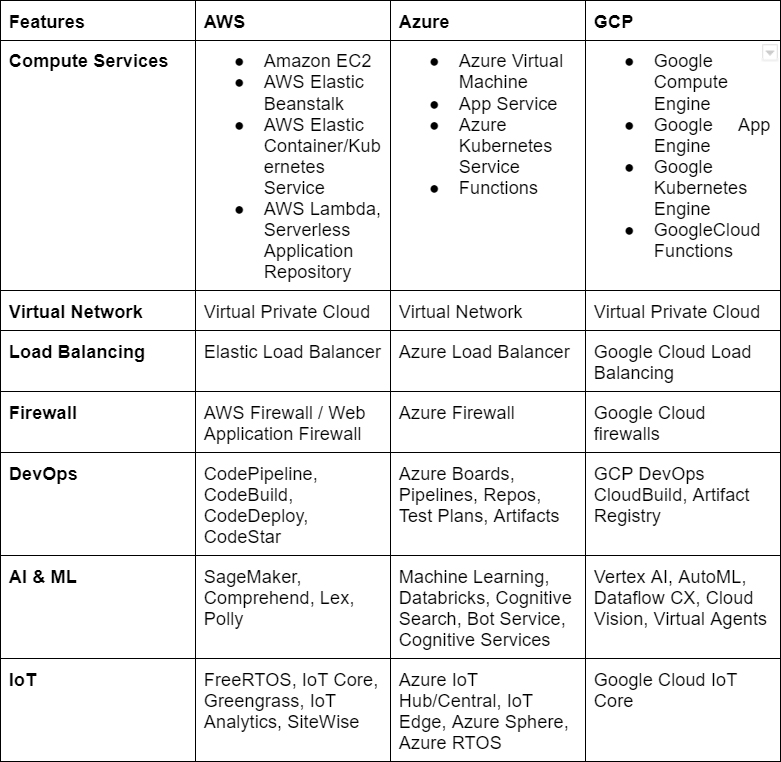
- AWS's primary computing service is the EC2 instance, which can be customized with a variety of features. AWS Lambda, EC2 container service, Elastic Beanstalk for app delivery, ECS (EKS) for Kubernetes, and autoscaling are all available.
- Azure's compute services, on the other hand, are focused on virtual machines (VMs), with many other tools such as cloud services, resource managers, and Azure autoscaling services to support the deployment of cloud applications.
- Google's customizable Compute Engine deploys virtual machines (VMs) in your data center. It has fast boot times, persistent disk space, high performance, and is highly customizable to customer needs.
- AWS storage services include Elastic Block Storage (EBS), Simple Storage Services (S3), Elastic File System (EFS), Glacier archival backup, bulk data import/export transfer services, and Storage Gateway to interact with local settings.
- Microsoft's Azure storage services include Azure Blob storage, Queue, Table, and File storage options. Also includes Import-Export, Site Recovery, and Azure Backup.
- All three platforms offer powerful networking features such as on-premises system connectivity and automatic server load balancing.
AWS vs Azure vs Google Cloud: Tools
Enterprise Cloud Servers provide a variety of tools and resources for enterprises. This section describes tools provided by AWS, Azure, and Google Cloud.
- AWS Tools:
AWS is at the forefront of bringing artificial intelligence (AI) and the Internet of Things (IoT) to enterprises, using SageMaker to train employees and enable machine learning. This gives the user access to his Lambda serverless compute environment and allows him to deploy apps directly from the serverless repository. For even more customization, AWS also integrates with various enterprise IoT solutions.
- Azure Tools:
Cognitive Services and artificial intelligence enhancements available in Azure Tools.
Cognitive Services is a set of API-based tools that enable on-premises integration of Microsoft software and business applications.
Functions is the only serverless solution to coordinate and manage complex workloads, driven by events. For IoT, Microsoft offers Edge that can be used for management and business analytics.
- Google Tools:
Google's cloud-based enterprise benefits include natural language translation and speech-to-text conversion to help enterprises move from global collaboration to machine learning application development. TensorFlow, a large open source library, is also available. The Internet of Things and serverless systems are still in the early stages of development.
- AWS vs. Azure vs. Google Cloud: Pricing
Pricing across platforms can be a significant incentive for those looking to move to the cloud, and for good reason. Prices have been steadily declining amid the battle of the big cloud providers for some time.
- AWS:
To help you understand the pricing aspects, we have our own pricing calculator. However, due to various types of taxes and duties, we strongly recommend that you check the final cost before purchasing.
Microsoft Azure: Pricing for Microsoft Azure is much simpler. Your dashboard has a billing section where you can see everything. You can also use the Azure Pricing Calculator to find pricing for cloud-based services.
- Google Cloud:
When it comes to simple pricing standards, Google's pricing structure stands out as attractive and customer-friendly. Therefore, it is one of the best cloud servers for small businesses.
AWS Vs Azure Vs GCP: Quick Comparison in 2023